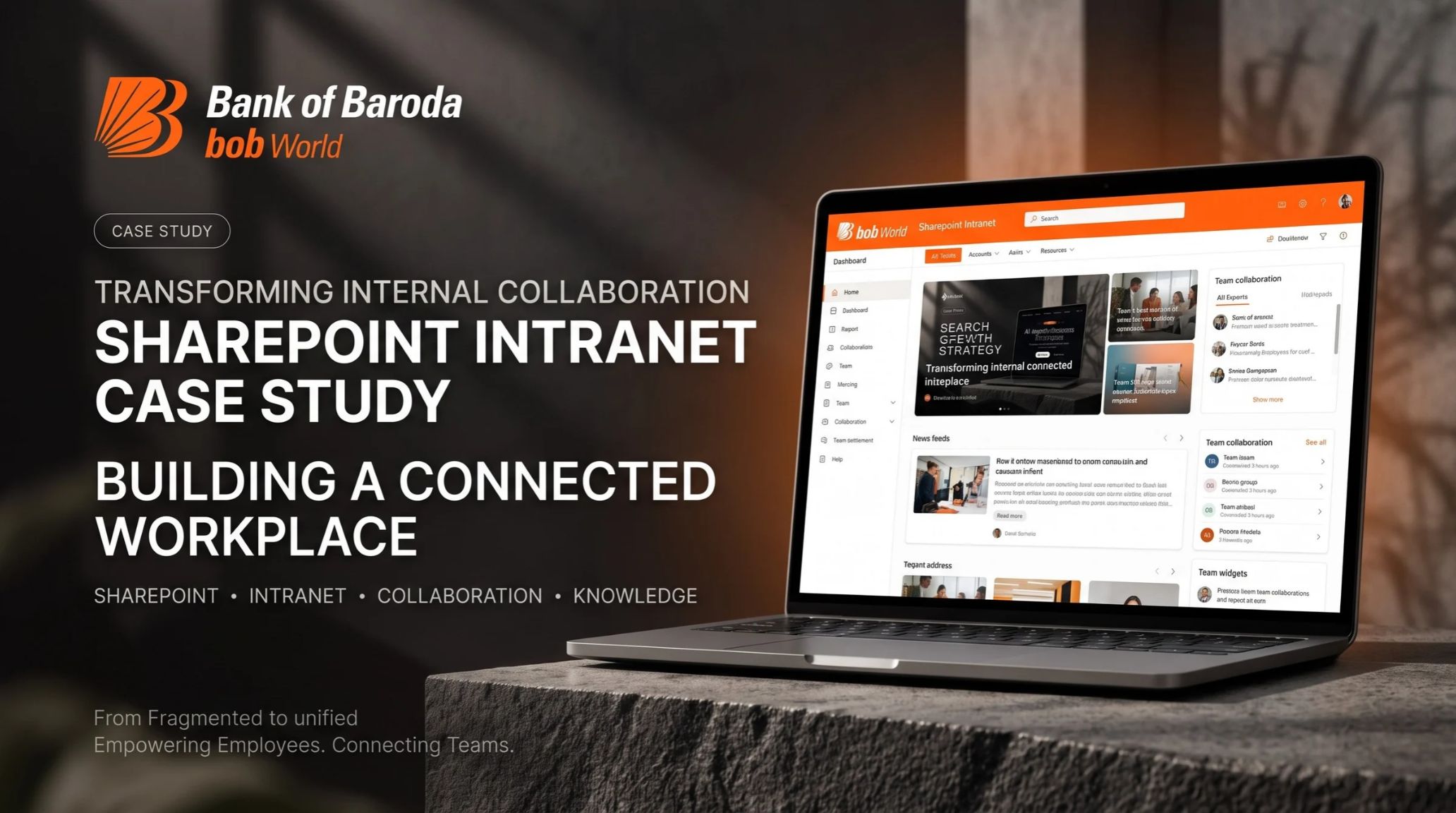
Bank of Baroda — SharePoint Intranet Portal
Building a SharePoint intranet portal for Bank of Baroda to bring internal communication, announcements and documents into one place for teams across the bank.

Client
Bank of Baroda
Industry
Banking & Financial Services
Services
SharePoint Development, Intranet Portal, Internal Communication, Information Architecture, UI/UX Design
The Challenge
Critical internal communication with no single home
Internal updates, circulars and documents were spread across long email threads, shared drives and separate systems. Teams across departments had no single, reliable place to find the latest announcement or the current version of a document, and important communication was easy to miss.
Why this matters more in banking
In a bank, circulars, policies and procedural updates are not announcements — they are operational instructions. Staff need confidence that the version in front of them is the current one before they act on it.
When the same document exists as several mail attachments of different ages, that confidence disappears. People fall back on asking a colleague, which is neither fast nor reliable, and the organisation ends up depending on institutional memory for things that should be a matter of record.
Why email makes it worse
Email compounds the problem rather than solving it. A circular sent to a distribution list is findable only by whoever still has the mail, in whichever folder they happened to file it.
Anyone who joined afterwards has no access to it at all. So institutional knowledge accumulates in individual inboxes instead of in the organisation, and every new joiner starts from zero on material that has existed for years.
It also makes communication impossible to verify. There is no way to confirm that a department actually has the current policy, because there is no single place where the current policy lives.
The constraint that shaped the solution
Bank of Baroda needed one internal communication portal that every team could rely on — and it needed to work within the environment and controls the bank already had, rather than introducing a new platform to secure and administer.
What needed to be solved
One reliable source for announcements, circulars, policies and forms.
Version control, so staff always open the current document rather than an old attachment.
A structure navigable by someone who does not know where a document lives.
Content and access organised by department and role, without cutting teams off from bank-wide communication.
A build on the bank’s existing Microsoft 365 environment — no new login, no separate infrastructure.
Controlled publishing, so updates are issued deliberately rather than informally.
Usable by a new joiner from their first day, with no prior context.
What We Did
We brought internal communication into one structured portal.
Our approach
We treated the portal as information architecture first and interface second. A well-designed intranet nobody can navigate is the same failure as having no intranet at all — people simply go back to asking colleagues.
01 — Information architecture
We mapped departments, content types and audiences to decide what belongs on the homepage, what sits inside each department space, and how people would actually navigate to it.
The test applied throughout was the new-joiner test: could someone with no history in the organisation find a specific policy without asking anyone? That is a far stricter standard than whether an existing employee can find it, and designing to it benefits everyone — including the long-serving staff who had simply memorised where things were.
Mapping audiences alongside content also settled the question that determines whether an intranet stays useful: what should be bank-wide and what should be departmental. Get that wrong and the portal becomes either noise or a set of silos.
02 — SharePoint portal build
The portal was built on the bank’s existing Microsoft 365 environment, so there was no new login to manage and no separate infrastructure to maintain.
For an organisation of this kind that decision carries real weight. Building inside the existing environment means identity, permissions and governance are already handled by systems the bank controls and has already approved, rather than introducing another platform to secure, audit and administer.
It also removes the single biggest barrier to internal adoption, which is another set of credentials. A portal staff are already signed into is a portal staff will actually use.
03 — Announcements and document hub
A single place for announcements, circulars, policies and forms, with version control so teams always open the current document instead of an old copy from a mail attachment.
Version control was the point of the exercise rather than a feature of it. Once a document has one authoritative location, the question staff were previously asking each other — is this the latest one? — stops being a question at all.
That is also what makes the portal defensible as a record. The current version is not a matter of whose inbox you check.
04 — Department and role-based access
Content and permissions were structured by department and role, so each team sees what is relevant to them without losing access to bank-wide communication.
The balance matters in both directions. Too broad, and genuinely important announcements are lost among material that does not apply to the reader, which trains people to ignore the portal. Too narrow, and teams miss communication they needed.
Structuring access by department while keeping bank-wide channels open to everyone addresses both failure modes at once.
Services delivered
SharePoint development
Intranet portal build
Internal communication structure
Information architecture
UI/UX design
The Outcome
One portal for every internal update.
Announcements, documents and policy updates now live in one portal with a clear structure and proper version control. Teams know where to look, communication reaches the right departments, and the portal runs inside the Microsoft 365 setup the bank already uses.
Internal communication moved out of individual inboxes and shared drives and into a structured, governed location that a new joiner can use from their first day.
1 portal
Replacing scattered email threads, shared drives and separate systems with one authoritative location.
Built on existing Microsoft 365
Running inside the bank’s own environment — no new login, no separate infrastructure, and identity and governance handled by systems already in place.
Role-based access by department and team
Content and permissions structured so each team sees what applies to it without losing bank-wide communication.
Employees
One place for announcements, policies and forms, with confidence that the version shown is the current one.
Departments
Own spaces for team-specific communication and documents.
Administrators
Controlled publishing with structured access by role.
What this unlocked
An information architecture that further departments and content types can be added to, so internal communication keeps consolidating rather than fragmenting again as the organisation changes.
Replacing scattered emails & drives
Built on existing Microsoft 365
Access by department & team


