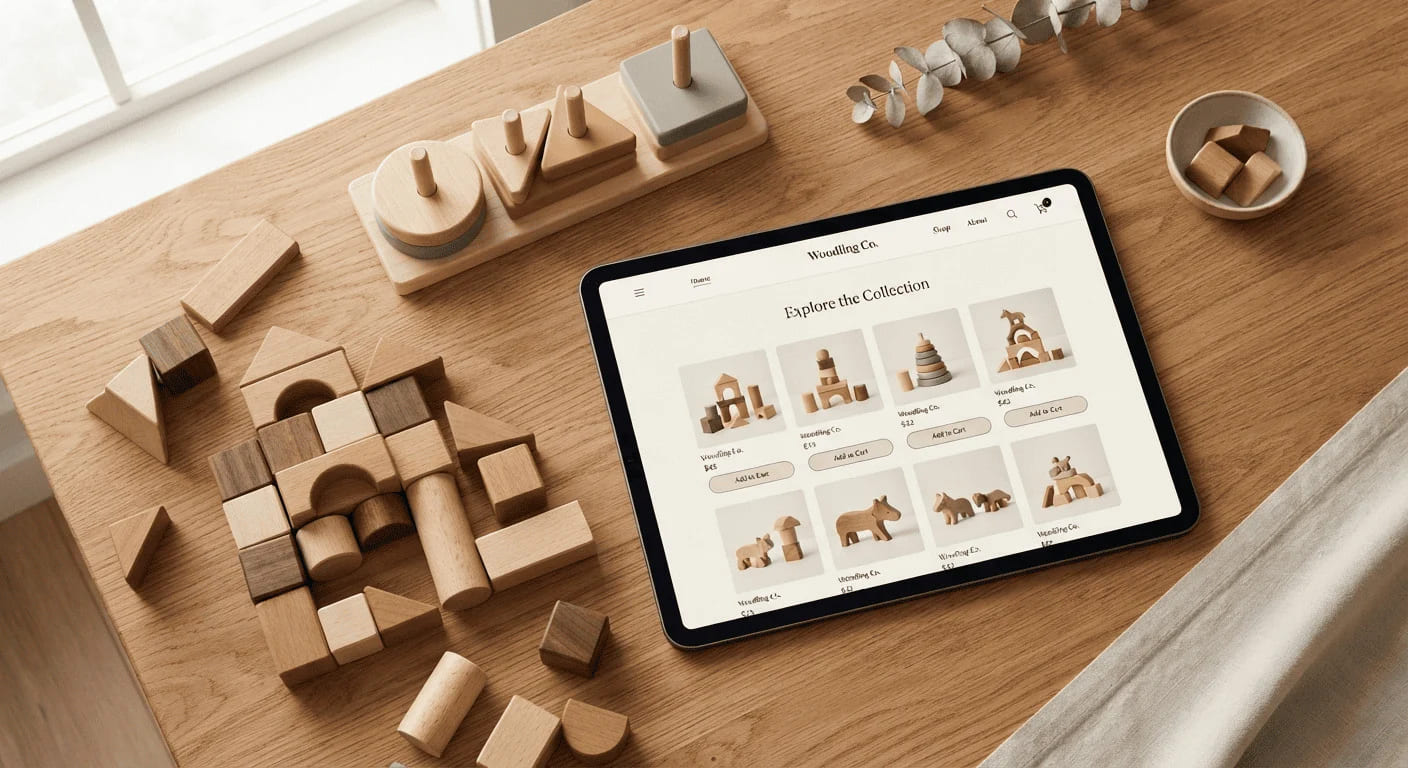
Woodling Building a Digital Storefront for Learning Through Play
Developing a product-focused website for Woodling to bring its educational toys, puzzles and children's furniture into a structured digital storefront.

Client
Woodling
Industry
Educational Toys & Children's Furniture
Timeline
1 Month
Services
Website Development, E-commerce Development, UI/UX Implementation, Website Management
The Challenge
A wide, varied catalogue that had to stay easy to browse
Woodling needed a digital storefront that could present a broad product range while keeping the shopping experience simple to explore. The catalogue spans educational toys, puzzles, stacking toys, DIY kits, lawn games and play-school furniture — products that differ in size, price, purpose and buyer.
Why breadth is the difficulty
A parent shopping for a two-year-old and a play school ordering furniture in bulk are looking for entirely different things. One is browsing for a gift under a price ceiling; the other is sourcing against a specification. A single flat product list serves neither.
Without a clear category structure, a wide catalogue stops being a strength and becomes a reason to leave. The visitor cannot tell whether the right product exists, so they assume it does not. That is the specific commercial risk of range without structure: the inventory is there, and the customer never finds it.
Trust is part of the product
There is a second consideration particular to this category. Wooden educational toys are bought on trust as much as on product. Parents want to know the material is safe, the product is genuinely age-appropriate, and the brand takes craftsmanship seriously.
Those signals cannot sit in one paragraph on an about page and be expected to work. They have to be present at the moment of doubt — which is on the product page, seconds before a decision. A storefront that states its values somewhere else entirely is not actually reassuring anyone.
Age suitability deserves the same treatment. For educational toys it is the single most common filter in a parent’s head, and leaving it buried in a description costs both abandoned sessions and avoidable returns.
What needed to be solved
A professional e-commerce website to establish a stronger online presence for products previously sold largely offline.
A wide product range requiring a clear category and navigation structure rather than one long catalogue.
Products presented with detailed information, images, pricing and benefits — enough for a parent to decide without asking.
A website communicating the focus on wooden, educational and child-friendly products, with material and safety reassurance where it counts.
Distinct categories — educational toys, puzzles, stacking toys, DIY kits, lawn games, furniture — each findable in its own right.
A smooth path from product discovery to purchase, with age suitability visible early.
A structure able to support new products and collections as the brand grows, without a rebuild.
How we framed the brief
The challenge was to create a website experience that reflected the brand’s product-led, learning-through-play approach while giving it a practical foundation for online browsing and future catalogue expansion — delivered quickly enough to start selling rather than perfected indefinitely.
What We Did
We built the storefront around how parents actually shop for toys.
Our approach
The organising principle was that nobody browses a toy catalogue the way a warehouse organises it. Parents browse by child — by age, by what the toy teaches, by occasion, by budget. So the structure was built around those entry points rather than around internal product groupings.
The build was delivered in one month. That timeline shaped the priorities deliberately: get the things that decide a sale working properly — browsing, product clarity, checkout — rather than shipping a larger build that looked impressive and converted poorly.
01 — E-commerce Website Development
Fameweb developed the Woodling website as a product-focused e-commerce platform, creating a structured digital storefront where customers can explore the brand’s wooden toys, educational products and other collections.
For a brand moving from offline-led selling to online, the first version of a store has one job: prove that the catalogue can be browsed and bought. Everything that does not serve that was treated as a later phase.
02 — Product & Category Structure
We organised the website across 50+ category and discovery paths, making it easier for visitors to navigate educational toys, puzzles, stacking toys, lawn games, DIY kits and other collections.
Categories were defined by how a buyer thinks about them rather than by how stock is grouped internally. A puzzle and a stacking toy may sit together in inventory, but a parent searching for one is rarely satisfied by the other — so each got its own clear route.
This is also what makes a broad catalogue feel manageable instead of overwhelming. The range did not shrink; the number of decisions a visitor has to make before seeing something relevant did.
03 — Product Page Development
Product pages were structured to carry the information that actually drives the decision: product details, pricing, specifications, recommended age and benefits.
Recommended age was treated as a primary structural field rather than a line in the description. Surfacing it early prevents two distinct losses — the visitor who leaves because they cannot confirm suitability, and the customer who buys the wrong thing and returns it.
Benefits were framed in terms of what the toy develops, which is the language parents actually use when choosing educational products.
04 — User-Friendly Shopping Experience
We focused on a straightforward browsing and shopping journey, letting users move from category to individual product to purchase with as little friction as possible.
Every additional step between interest and checkout costs orders. The journey was kept deliberately short, with particular attention to mobile, where most browsing in this category happens — often one-handed, often with a child nearby, rarely with patience to spare.
05 — Brand Presentation
The website was structured to communicate Woodling’s focus on craftsmanship, learning through play, child-safe products and responsible use of wood — the themes central to the brand.
These were placed where they do commercial work rather than only on an about page: material and safety reassurance near the product decision, and the learning-through-play positioning built into how categories are framed.
In a category where trust decides the purchase, reassurance has to be adjacent to the moment of doubt. Moving it there is a structural choice, not a copywriting one.
06 — Scalable Website Structure
The website was developed with a structure that can accommodate additional products, collections and requirements as the brand expands — built to absorb 20+ further additions without structural rework.
For a growing toy brand adding seasonal and festive ranges, that flexibility is the difference between launching a collection in a week and rebuilding the site every year.
Services delivered
Website development
E-commerce development
UI/UX implementation
Ongoing website management
The Outcome
A storefront that makes a broad catalogue feel simple.
A structured, product-focused website that gives Woodling a stronger digital storefront for its range of educational toys, puzzles, DIY kits and children’s furniture — delivered in one month and built to grow.
The brand moved from offline-led selling to having a working online storefront, with a structure that lets new ranges go live without a redesign.
50+ category and discovery paths
The catalogue organised so a parent can browse by category and age rather than scrolling one undifferentiated product list.
1 complete storefront
A practical online store supporting product browsing and the full purchase journey, built and live in a month.
20+ further additions supported
A website foundation that can take on more products, categories and content as the catalogue grows, without structural rework.
Organised Product Experience — products structured across multiple collections rather than one flat list.
Improved Product Discovery — browsing by category and age, matching how parents actually search.
Detailed Product Presentation — dedicated pages carrying specifications, recommended age, benefits and pricing.
Stronger Brand Experience — craftsmanship, child safety and educational positioning connected to the product decision itself.
Complete Digital Storefront — discovery, product information and purchasing in one connected journey.
What this unlocked
A catalogue this broad can now be presented without overwhelming the buyer — and seasonal or festive ranges can be added as collections rather than as development projects.
Organised the website experience around product categories and easier discovery across the catalogue.
Built a practical online storefront to support product browsing and customer purchase journeys.
Created a website foundation that can accommodate additional products, categories and content as the catalogue grows.


